Reflections on 12-12-12: No ordinary Wednesday


by @PaulFiarkoski

I’m not into numerology, so I don’t believe anything special happens when numbers line up in a certain way. That said, all the hype with 12-12-12 could have came and went for me with almost no significance. Same for last year on November 11, and October 10 the year before that. August 8, 2008 (08-08-08) was sort of cool since it was my sister’s birthday – and the day of the opening ceremonies for the Beijing Olympics.

My lack of interest in a numerically significant date notwithstanding, somehow a switch was flipped for me the morning of December 12, 2012. It actually started the night before when my 11 year-old daughter made me pinky promise I would take a picture of my iPod screen for her at exactly 12:12 pm since she would be at school.

Couldn’t avoid the buzz
When I checked in on Facebook the morning of the 12th, my feed was lit up with all things 12-12-12. Same thing on Twitter. One post in particular stood out to me: ” 12.12.12 …I have the DVR all ready to go!,” a friend from my high school posted. It was then that I remembered hearing about the benefit concert taking place later in the day at New York’s Madison Square Garden. I promptly set my DVR too.

Time check
I worked from home that day and started my lunch hour at exactly 12 noon, so could I stay focused on upholding the pledge I made to my daughter. An added bonus was being able to hug and kiss my wife like we do each New Year’s eve at midnight. I captured the special moment on my iPod and posted the image on Facebook with a snarky comment about surviving 12-12-12. Even though I know the Mayans alleged apacolypse was allegedly not to occur until December 21, so many people mistook the twelfth for D-day that I decided to play along.
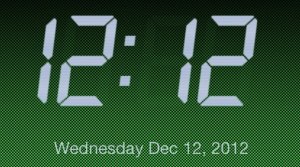
The screen shot I took of my iPod screen at 12:12 on December 12, 2012.

Benefit concert
The day continued as any usual Wednesday would until 6:30 local time when the 12-12-12 benefit concert came on the tv. What a line up! When it kicked off with Bruce Springstein and Bon Jovi I quickly realized this was going to be a big event. The legends just kept parading out, one after another. Roger Waters (Pink Floyd), Eric Clapton, Mick Jagger, the Who. Honestly, I got chills a few times just sitting there watching these larger than life rock stars humble themselves for the cause of raising money for those suffering from the effects of SuperStorm Sandy.

I checked in on Facebook and Twitter a couple times during the show to see how others were reacting to the performances. Most were impressed, although there were a few low points. Kanye West comes to mind. A personal favorite for me was Adam Sandler’s rendition of Hallelujah. An instant classic! The biggest shock for me was that Alicia Keys did not sing her hit “New York”. Maybe I’ll find out when I play the rest of the concert on the 13th that it was part of a finale. I hope so.

Like Farm Aid on steroids
Here was my one-liner that summarized how I felt about the concert: Farm Aid has been working out and taking roids for the last 25 years and has re-emerged as the #121212concert for Superstorm Sandy victims.

I mentioned to my wife that when we look back at tonight in ten years or so, we’re going to realize this was a bigger event than Woodstock, BandAid or any of the other big time concert events.

Meteor Shower
Another topic that others were commenting about on social media was the Geminid Meteor Shower – an event I would not have been aware of were it not for Facebook. Then Kanye West took the stage. About 45 seconds into his act I decided then was a good time to make a break for the hot tub. Everyone else in the family had already dozed off, so I was solo. Low and behold, I saw a few streaks from the meteors whizzing through the night sky, high above South Mountain on the south edge of Phoenix.

I still don’t believe there is any thing special about how certain numbers line up. But thanks to the large contingent of others that do believe, 12-12-12 was anything but an ordinary Wednesday for me.

How to survive without cable or satellite tv


by @PaulFiarkoski

In 2012 my family of four decided to chase after the notion of financial peace. It was a decision that my wife and I made, but we made sure to include the kiddos in on the plan so as to explain why some things would be changing around the house.

GE indoor outdoor antenna
This medium quality indoor/outdoor HD antenna cost about $40 and delivers all the network and local channels in high definition.

Although I didn’t earn any popularity points for this one, I made the executive decision that we would be cutting DirecTV out of our budget after about fifteen years of loyal subscribership. It wasn’t easy at first but we’ve adjusted, and now we rarely miss the hundreds of channels we had access to but rarely watched.

How we did away with satellite TV
Since we already had a HDTV, I purchased a medium quality digital antenna for about $40 that I mounted on the side of our house nearest the radio and tv antennas perched atop South Mountain in Phoenix. After running the channel scan, we ended up with about 40 channels that are viewable; however, roughly a quarter of them are Spanish only stations and another quarter program content we would consider only on the most sleepless of sleepless nights. We do get all of the majornetwork channels that accounted for about 80% of our viewing when we had satellite. Most of the channels we watch now are in high definition, so we’re actually getting a higher quality picture than satellite at no cost.

Stretching our dollars with technology
So as to make sure we could watch the shows we want when we want (a habit we developed thanks to the DVR satellite receiver), I did spring for a Tivo box at a cost of about $70 and a $20 monthly service fee. I also pay for high speed internet from the local cable company and have the internet connection wired directly to the Tivo box. The internet connection means we can stream videos from Netflix ($8 a month for unlimited movies and programs) as well as free videos and programming available from YouTube and Tivo.

For music channels similar to the satellite radio stations on DirecTV, we now stream our favorite Pandora channels. We can also now surf the web, shop or play games with others around the world on the Wii console that’s also wired to the tv.

There are still moments when we really miss some of the stuff we used to watch on channels we no longer get. For instance, my wife and daughters used to love watching Dance Moms. When Superstorm Sandy battered New Jersey and New York, I really wished I had The Weather Channel.

Update (Jan. 1, 2012): I may be a little slow, but I just discovered that we can watch ESPN and a number of cable networks on the iPad, thanks to the growing number of available apps.

Bottom line
We gave up a monthly satellite bill of about $80 in exchange for our current cost of $28 (Tivo and Netflix) – a savings of $52 a month. That’s over $600 a year we’re saving for giving up very little. It may not be worth it to a lot of people, but we are laser focused on cutting our expenses and paying down debt.If it sounds good to you, I would suggest you try pulling the plug on cable (or satellite) and see how much you can save too.

Confessions of a surprised Phoenix newcomer


by @PaulFiarkoski

One Saturday morning during my first holiday season as Phoenix resident I was out running a few errands. Being new to the area, a lot of things on the radio caught my attention, like the promo for a car dealership that was hosting a radio station for a live remote on this particular day.

I wasn’t in the market for a car, but something about the announcer drew me in as she rattled off a few today only specials then invited us listeners to “come on out and see ’em for yourselves” at one of two locations.

Surprise, AZ
Surprise, AZ is a real place

When she gave the first location I could visualize it on a map in my mind. It was the second location – the “surprise location on Bell Road” – that confused me.

“Hello!” I thought to myself. “It’s not a surprise if you give the location.”

I couldn’t believe my ears as I played back the for-sure radio blooper in my head. “What a fool,” I remember thinking. “She totally blew the surprise and gave out the location. She’ll be lucky if she’s not fired on the spot.”

About fifteen minutes later I realized the fool was me. I mentioned the DJ’s blunder to a convenience store clerk, who very politely wondered aloud “Could she have been talking about a location in the town of Surprise?”

Doh! Imagine my surprise.

Tips for a productive household budget meeting


by @PaulFiarkoski

After seventeen years of marriage and countless arguments over money, my wife and I recently got serious about getting out of debt. We’ve been following the Dave Ramsey Total Money Makeover program where you take a series of steps with the ultimate goal of becoming completely debt free. First you cut out all frivolous spending and set aside $1,000 in savings. Then you start attacking all your debt from smallest loan to largest. After all your unsecured (no collateral) debt is paid off, you get aggressive with investing.

Pen and paper
For best results, take time to prepare for your household budget meeting.

One of the keys to cutting out frivolous spending is to hold a monthly budget meeting, presumably with your spouse. It’s a good idea for domestic partners and single people too. We’re prepping for our third monthly budget meeting and are really starting to see some results – mainly in the way of fewer arguments over money.

Below are some tips that we have found help us have successful budget meetings and outcomes. If you have questions, post them in the comments and I’ll respond the best I can.

Set some ground rules
Create some simple ground rules to review at the beginning of each meeting. You should read them out loud before getting into the money discussion. We have found it’s also good to pray before starting the money talk to get our heads and hearts in the right place.

Here are the ground rules we abide by:

  1. We’re a team and we’re doing this activity for a mutually beneficial outcome.
  2. It’s not about judging or finding fault; it’s about being responsible stewards with the gifts God blesses us with.
  3. Each will listen and respect the other’s feelings and opinions.
  4. We are not perfect and we won’t do it perfectly but we must get better over time.

Have an agenda
Make the best use of your time by sitting down with specific talking points and outcomes in mind. We use the same agenda from month to month. Below I have outlined the key things we talk about.

Track progress with net worth
Having been a registered financial consultant for over a decade, I learned that the best way to measure financial progress is net worth. Net worth is a pretty simple calculation; although gathering up the numbers can be a chore.

To calculate net worth, add up all your assets (what you own) and subtract your debt (what you owe). Include everything – home, cars, timeshares, retirement accounts, etc. On the credit side include all your debt, even credit cards and no short term furniture loans, etc.

Here is what we include in our net worth calculation:

Net Worth = Assets – Liabilties
Assets
Checking
Savings
Health Savings
Retirement account
IRAs

Liabilities
Mortgage
Overdraft line of credit
Medical bills

Pulling together the net worth data takes some time, but talking about it takes only about a minute. What I do is gather up the data and have it all set to go in a one page report prior to the monthly meeting with my wife. Websites like mint.com simplify this monthly task by aggregating multiple financial accounts into one application. Many banks and credit unions now offer these online aggregation services too.

The idea is to look at your net worth on a regular basis to see if it’s increasing or decreasing. It’s sort of like using a scale to keep track of weight loss.

Wins and losses
Next, talk about what you did well last month from a budget standpoint. This can be a great opportunity to score brownie points with your partner if you approach it right. Focus on things each other did well, rather than spotlight ways where the other blew it. This doesn’t mean you should ignore obvious “withdrawals” of fiscal trust; just be careful in how you approach shortcomings on the part of each other.

Talk about things that pulled you off course.  If talking about who spent how much on coffee, nails, hair, etc. is likely to start an argument, consider making the decision that each of you get a set amount of cash each month to spend as you wish. Then take that cash out at the ATM and don’t hold each other accountable to it.

What’s coming up
Once you have made it through what will likely be the most emotionally charged part of the meeting, talk about what the next month looks like in terms of money coming in and money you need to pay out. I have found it helpful to use spreadsheet and plot out every day of  the coming month and what money we expect to receive or to pay out. It’s time consuming and sometimes painful, but it’s what you will do if you want to break out of a financial rut.

Agreed goals
Finally, close the meeting by reminding yourselves of the financial goals you have in common and discuss how you’re tracking to meet them. If you haven’t established any goals, consider starting with the baby steps that millions of debt-free Dave Ramsey followers have based their success on.

How often to meet
My suggestion is to have the budget meeting once a month for starters. Sit down in a distraction free environment at least an hour and talk it out. We get together on the back patio. Stay in constant communication with each other about the budget, especially when one of you is about to spend money that wasn’t part of the last budget discussion.

Don’t put it off
The only way to fail is to not try it. Feel free to use some of the ideas that have worked for us or create your own approach. I have also found some great resources on Dave Ramsey’s website.

How to organize those you follow on Twitter with lists


Go ahead, follow anyone and everyone you want to on Twitter. Lists can help you keep them organized.

The trouble with following too many people
In the early days of Twitter, the prevailing wisdom was to not follow more people than follow you. I think the logic was that if you don’t have as many followers as people you follow, then you’re not worth following.

Another reason often given for keeping the number of people you follow on Twitter low was that your feed would be too cluttered if you followed too many people. I admit that after I followed more than a couple hundred people on Twitter, it was hard to keep up with it all.

How Twitter lists help you reduce clutter
Then Twitter lists came along in 2009 and changed all that. A list allows you to group the people you follow by category. Say for instance, you are a baseball fan and like to follow professional baseball players. You can create a list called Baseball.

Once you have created the list, adding people to it is easy. The process varies depending on whether you’re using Twitter on your PC, mobile device or an app on your mobile device so I won’t detail the steps here. Search ‘lists’ in the help menu of the Twitter application you’re using if it’s not plainly evident.

You can add one individual to multiple lists. As an example, I follow @DbacksBaxter – the team mascot for the Arizona Diamondbacks. I added D. Baxter to these lists: Sports, Arizona & Personalities. You don’t have to put everyone you follow on a list. Doing so is not wise in my opinion.

Example
You’ll see the real value of taking the time to set up Twitter lists after you have created a few. Let’s say you’re watching football on a Sunday afternoon. You click on your list called Football or Sports or NFL Fans – whatever you named it – to which you have added the people who play or are interested in football. Next thing you know you’re viewing only the tweets of people on this list who are presumably talking about the game(s). The tweets from others about weather, family or dinner are still out there; you just can’t see them for the time being because you have filtered them out.

Finding worthwhile people for your lists
A good way to find people to follow and add to your lists is to search a key word or hash tag when you know people are tweeting about a particular topic. Want to find other baseball fans to follow? Search #worldseries during the World Series. Try the same for #grammys or #oscars or any particular shows you like to watch. When you see a tweet you like, follow the person that tweeted it and add them to your list for that topic. You can do the same for other areas of interest.

Shortcut: follow other people’s lists
Maybe you think this is all too much work or just don’t have the time to manage one more thing. No problem, you can still take advantage of Twitter lists by following other people’s lists. The quickest way to find lists you might be interested in is to click on ‘Lists’, then ‘Member of’ while logged into Twitter on a PC. (Mobile Twitter apps may not offer this option.) This will show you the lists that others have added you too. Scan the lists and see which ones interest you most. If you like what you see after you click on the name of a list, you can subscribe to it. Now you have a list you can follow without having gone through all the legwork to create or manage it.

Top 100 Twitter lists
If nobody has added you to a list, see what lists some of your favorite people on Twitter have created. Or check out the Top 100 Twitter lists based on number of subscribers. Surely you’ll find a few that interest you.

Don’t let concerns about a little clutter keep you from following more people on Twitter. Instead, follow to your heart’s content and use lists to keep the people you do follow a little more organized.

Don’t let the ninja cactus get you


True story: I went out for a walk this morning well before the sun came up in our suburban Phoenix neighborhood. There is nobody out at this time of day, so I was a little suspicious when I saw someone standing completely still about 8 feet off the path, lurking in the shadows.

The Cactus Ninja, courtesy Flickr
All rights reserved by EN AJUSTES

At first I thought the person was waiting for his dog to do its business, but alas – no dog. I got closer and closer and he didn’t so much as move a finger. “Does this guy think he’s a ninja?” I began to wonder. “Should I get ready to defend myself?”

It wasn’t until I was about 15 feet away, that I realized the alleged perpetrator was a cactus, standing just as it had for the past several years. As you were…

Buying health insurance in the Obamacare era


by Paul Fiarkoski

The Affordable Care Act – aka Obamacare – has become a hot political topic as of late. Oddly, this issue has divided even voters registered within the political parties.

From my perspective, much of the talk before the Obama healthcare plan went into effect was rhetoric based on fear. As a result of my insurance training, the notion of having everyone in the U.S. insured would spread risk across a huge pool of people and greatly reduce costs across the board.

Now that Obamacare has been in place for about a year, I’d like to share my family’s recent experience with the health insurance buying process.

Want the conclusion? Here’s mine: Obamacare is sorely needed in today’s economy.

Background
Due to a new career path I decided to take, my wife and I recently (July 2012) found ourselves in the market for health insurance for our family of four. I gave up the group insurance I had for the last twelve years and decided to pay out of pocket for a high-deductible individual policy. We have two tween-aged daughters. The company we dealt with is Aetna. That’s who I had the group policy with and who I applied for the individual policy with.

I thought it would make things simpler to stick with them since every one of our health insurance claims went through Aetna for more than a decade. I couldn’t have been more wrong. We still had to document for them every doctor visit, illness, etc. over the past ten years. When I suggested that they look up our claims and base their decision of whether or not to insure us based on their records, the representative said they couldn’t do that due to privacy laws. Right from the script!

Playing by the insurance company’s rules
Really? Privacy laws prevent me from giving my own insurance company access to their own files containing information about my health. I didn’t like that answer but played along since I really didn’t want my family to be uninsured.

As it turned out, my wife was denied coverage completely. And not just for me misstating her height and weight. It was that, combined with something that was not discovered in the physical but that my wife mentioned to the doctor, who logged it in her notes to the insurance company. We paid out of pocket to have the doctor treat the other matter, then appealed Aetna’s decision knowing in our minds that my wife would likely not be able to get coverage with another company now since one of the key questions on a new application is “Have you ever been denied coverage by any insurance company?”

I was issued a policy but with a 40% higher premium than I was originally quoted. Even though the bloodwork that I paid out of pocket for revealed that I’m in better health than I was five years ago, they rated me for “pre-diabetes,” likely because I mentioned on the application that a family member has diabetes. Great, now I’m paying more for revealing information that is none of Aetna’s business and they would have otherwise had no access to. Both of my kiddos were issued policies but one of them was rated higher due to an injury she sustained at gymnastics practice six months earlier.

At that point I couldn’t help but wondering if I had not mentioned the gymnastics injury, or my family member’s diabetes, or if I had been accurate with my wife’s height and weight, would we be having any of this trouble. Would Aetna have detected omissions on the application by checking our claim history? Call me a cynic, but my hunch is that yes they would.

Light at the end of the tunnel
Currently I and my two kids are insured. My wife is still uninsured as we await the outcome of the appeal. In the meantime, thanks to a tidbit I found in small print on Aetna’s denial letter, my wife will be eligible to apply for a “no pre-existing conditions” policy in early 2013. Prior to Obamacare this option would not have existed. I have already checked the premiums and the cost is about 30% higher than what Aetna originally quoted us. Chances are that even if Aetna does decide to cover her, it will be at an increased rate.

Regardless of the outcome, it is good to know that thanks to Obamacare we have the ability to get insurance for my wife. We just need to pray that she remains healthy until her insurance kicks in.


Option for people who have been denied health insurance
Apply for insurance under the Pre-existing Condition Insurance Plan made possible by the Affordable Care Act. Get details at www.pcip.gov


As for the runaround and rated policies we received from Aetna, I don’t attribute that to Obamacare. Having dealt with them for the last twelve years for my group policy, I have become wise to their archaic infrastructure and tendency to stonewall when it comes to paying out benefits.

Lessons learned
Here are some tips I would offer to anyone thinking about applying for an individual (not group) health insurance policy:

  • Don’t guess when completing the application. I guessed my wife is 5’8′ and 120. Although I scored big points with her for that one, Aetna said she was too thin to be considered for coverage.
  • Don’t overshare. Since insurance companies are allgedly prevented from obtaining health information about your relatives, don’t reveal anything. Make them insure you based on your health.
  • Apply to more than one company about three months before you need the coverage. That’s about how long it can take to get insurance from the time you apply. This way you can go with the company that offers you the best overall package (price, service, efficiency) and tell the other(s) you won’t be needing them.
  • Keep detailed records of medical treatments you and your family members receive. It will save you a lot of grief if you ever have to apply for individual health insurance.

How to save over $6,000 a year with your dishwasher


Photo courtesy of lifehacker.com
Not just a dishwasher.
Think of it as a money saving machine.
Photo courtesy of lifehacker.com

Nobody in my family of four likes washing dishes. Especially not me. But we still take turns getting them done. Our system for determining whose turn it is works a little like the game of “Not it!”

As with any modern family, washing the dishes at our house means getting the scraps into the trash or disposal then placing them into the dishwasher. Not that hard, but we still despise it.

Inevitably my turn comes up at least once a week. I’ve been on this ‘Financial Peace’ kick inspired by Dave Ramsey, so I’ve adopted a little mind game to make doing the dishes a little more bearable.

I tell myself that for every load of dishes we wash we’re saving about $30. It’s not a precise calculation, but here’s the rationale: Typically we drop around $50 every time we go out to eat as a family. I guesstimate that we spend about $10 to $15 on groceries when we cook a meal at home. Add to that another $3 to $5 for water, electricity and dishwasher detergent. If you’re an accountant, you can factor in depreciation of the plates, silverware and dishwasher itself, but I prefer to keep things simple. So basically, we spend $20 for a meal at home instead of $50 at a restaurant. Voila – $30 savings.

Consider how this example can play out over a year’s time.  We run the dishwasher four to five times per week. Cha-ching! I estimate: we’re saving $120 a week by washing dishes at home. Multiply that by 52 weeks in a year. That’s a savings of $6,240 over the course of year. Now that’s something I can get excited about.

Economics of running the dishwasher:

$30 savings per load versus not dining out
$120 saved per week at 4 loads per week
x 52  weeks
$6,240 potential savings per year

Okay sure, nobody eats out 100% of the time; I get that. The point here is for me to find reasons to overcome my dislike for doing the dishes. And I’m telling you that the belief that I’m saving $6,240 a year does it for me.

The takeaway: If your family hates doing dishes as much as ours, calculate the cost of the alternative – dining out – or use my numbers. Once you have convinced yourself that washing dishes at home more often is better than dining out, it will give you the will to step up and wash dishes a little more frequently. That goes a long way in boosting your credibility when you assign the task to others in the household.

Ever wonder what happened to waterbeds? This explanation may surprise you.


By @PaulFiarkoski

Vintage 1990s waterbed

Shortly after relocating from Denver to Phoenix in the summer of 2012 my wife and I were in the market for a new bed. In the process, we met a furniture store owner who has been in the business for over 30 years. Saying he knows his stuff would be a gross understatement. This guy can school anyone in the business, regardless of their experience level.

Needless to say, he earned utmost credibility with me in just a few minutes. He also knows a lot about backs, especially bad backs. After all, he has helped many people over the years who had come to him because they just can’t get a good night’s sleep with their back/mattress combination. He even has a bad back himself.

Since my wife has back issues, I found it natural to ask the question: What kind of mattress do you sleep on? A waterbed was his answer, followed by a quick dissertation on flotation being the most natural fit for any body.

My look surely went from convert to disbeliever as I scanned the showroom looking for a waterbed.

“I don’t sell them. They don’t make waterbeds anymore,” he said.

The explanation
He went on to tell me that back in the 90s, the three S’s of the mattress industry (Simmons, Sealy & Serta) pooled together to buy out all the remaining waterbed manufacturing plants under the stated intention of modernizing the facilities. They ended up shutting them down altogether and in effect killed off an entire industry, leaving consumers with only their high margin spring-loaded and new age foam models to choose from.

Sounds like a far-fetched conspiracy theory, I know. But it’s not the first time I’ve heard of companies playing hardball to eliminate threats to their profits.

Makes me wonder if the three S’s are buying up landfills too. Have you tried to dispose of a mattress lately? The cost is outrageous.

Incidentally, we had to exchange the high-end memory foam mattress we initially bought for a moderately priced coil and pillow top model. That’s just what feels best on my wife’s back.

The moral? Higher cost doesn’t always equal better. And you can’t trust companies that start with the letter ‘S’.

About me


Paul Fiarkoski

Based in Phoenix, AZ | 303.241.1990 | campfiar@yahoo.com

Welcome to the new age of marketing. Social media, blogs, email, search engine optimization. These are the means by which marketers without huge budgets are making things happen today.

That’s me: a new-school marketer – experienced in traditional mass market approaches, yet up with all the latest techniques to pinpoint specific audiences. I know how to pull it all together and make things happen on a budget of any size.

Proficiencies

  • Blog setup and content management
  • CRM software
  • Facebook, Twitter, LinkedIn, WordPress, YouTube
  • Microsoft Office
  • Online communities
  • Video production & editing
  • Web commerce, auctions
  • Webinars